
A large dark pigeon with a bright yellow bill and feet, seen right across the trail from the Rangers Post to Kalalama.
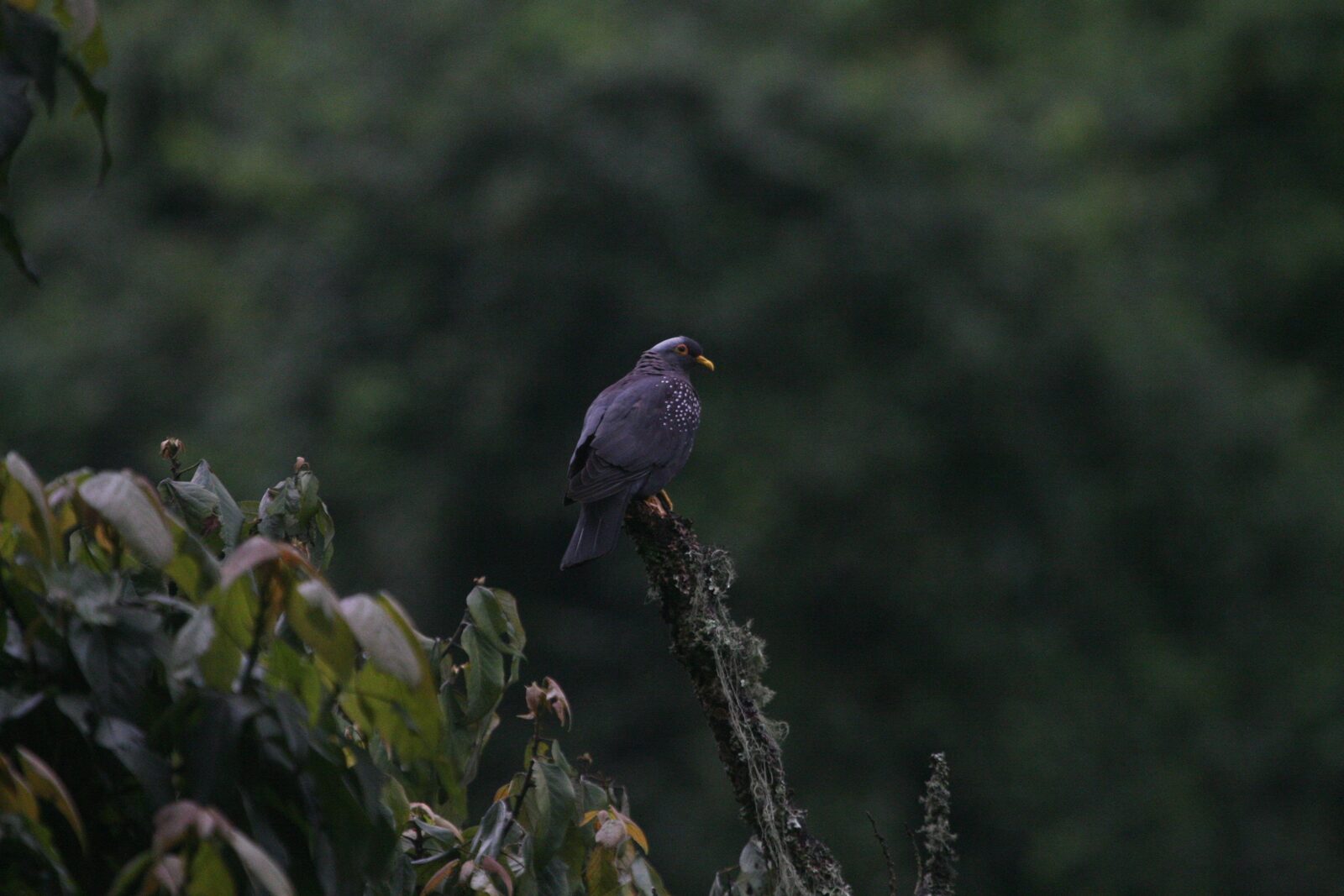
A very large dark-grey pigeon with a bright yellow bill, yellow eye-ring and feet, conspicuously spotted white on the wing-coverts and across the breast. The pale-grey nape can suggest White-naped Pigeon, but that species has plain dark wings. The female is slightly duller and the immature browner. In flight it simply appears very dark with a yellow bill and feet.
A deep vibrating "chuurrr" followed by a sequence of rising "ooo" notes.
In our area this pigeon is seen from 1,727 m to 3,190 m — from the Rangers Post to Kalalama via Sine Camp, and throughout the Samalira–Kihalo zone.
In the Rwenzori it feeds on the fruits and berries of trees such as Celtis africana, Maesa lanceolata and Macaranga kilimandscharica.
Breeding is tied to the fruiting season of its trees, from May to August, when pairs display around these trees and shift to high-altitude heather trees to roost at night. It is thought to nest in large heather trees, though little is known of the exact nest.
Flies considerable distances between roosts and feeding areas. Non-breeding and young birds form flocks, while breeding birds move in pairs. Seen all year on our trails — not a migrant.
Our guides know where to find it along the Kilembe Trail. Let us build a trek around the birds you most want to see.