
A striking red-faced francolin of dense forest and bamboo — shy and elusive, most often surprised on the trail.
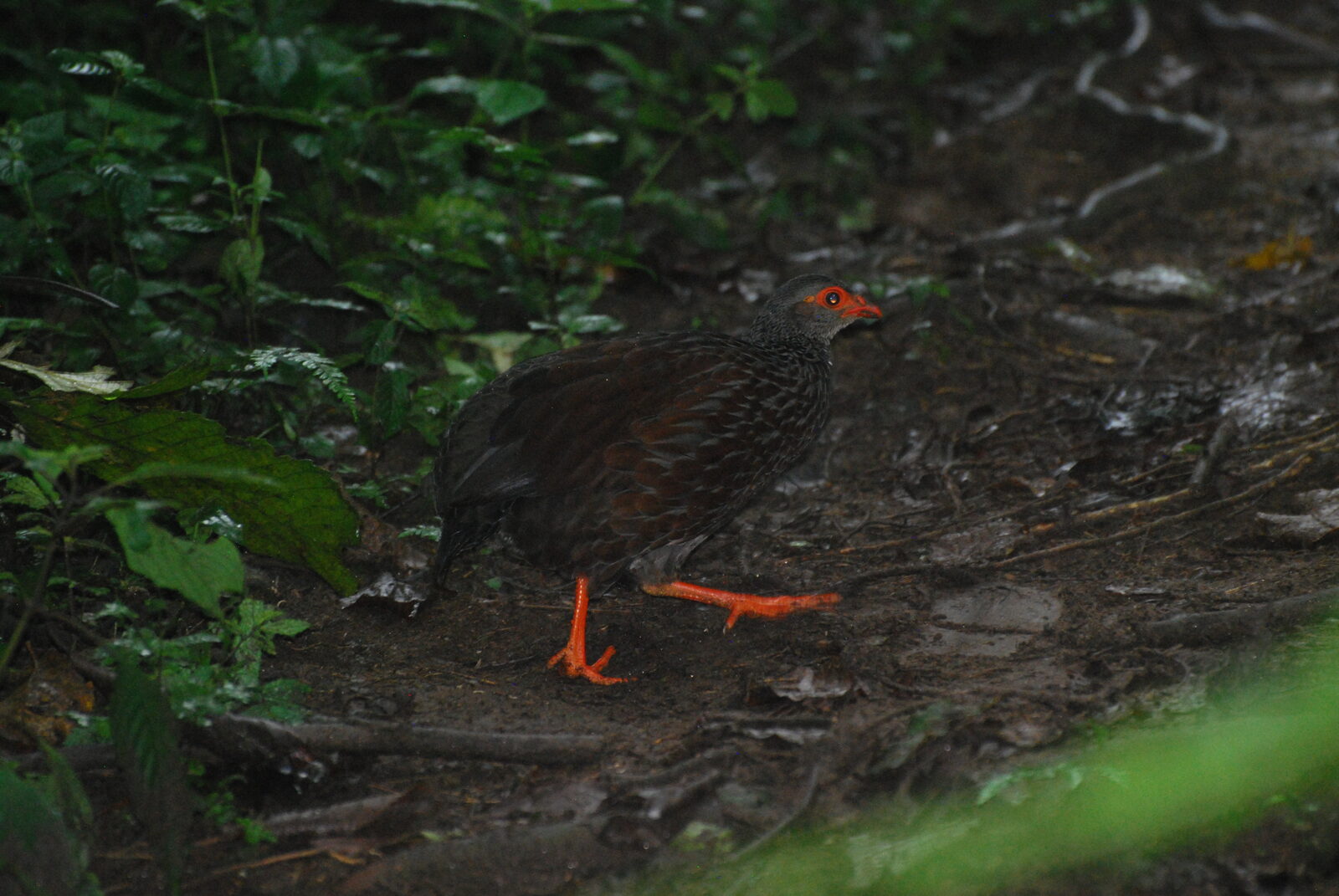
Most similar to Jackson's Francolin but with red skin around the eyes, more grey feathering on the neck and a totally different range. The female is smaller and slightly duller; the immature duller with dark-grey and tawny-barred upperparts.
Loud and musical for a francolin — a rising, repeated "kor-kik-ik", then a scratchy descending "kikek-kikeyk-kikoik".
Pairs and small groups inhabit dense forest and bamboo thicket from 2,150 m to 2,500 m in western Uganda, Rwanda and Burundi, most often seen on forest tracks at dawn and dusk. In our area (Kilembe trails) it is seen from 2,200 m to 3,400 m — the old lunch point on the way to Enock's Falls, the Second Shelter toward the riverside, and the whole bamboo zone to Samalela Camp, where it is more common than on other trails.
An omnivore, eating a great variety of foods — seeds and insects, grasses and weed seeds, cultivated grains, buds, flowers, leaves, rhizomes, tubers, shoots, fruit and berries.
Breeding is not well known, but is probably late April to July, when the ground layer is drier for the safety of the chicks.
A sedentary, ground-dwelling partridge that flies only short distances when pressed, otherwise walking cleared paths. Very shy and elusive — more often heard than seen, sometimes surprised feeding on the trail at dawn or dusk.
Our guides know where to find it along the Kilembe Trail. Let us build a trek around the birds you most want to see.