
A tiny Albertine Rift endemic with a broad black breast-band and two white "headlight" spots on the forehead.
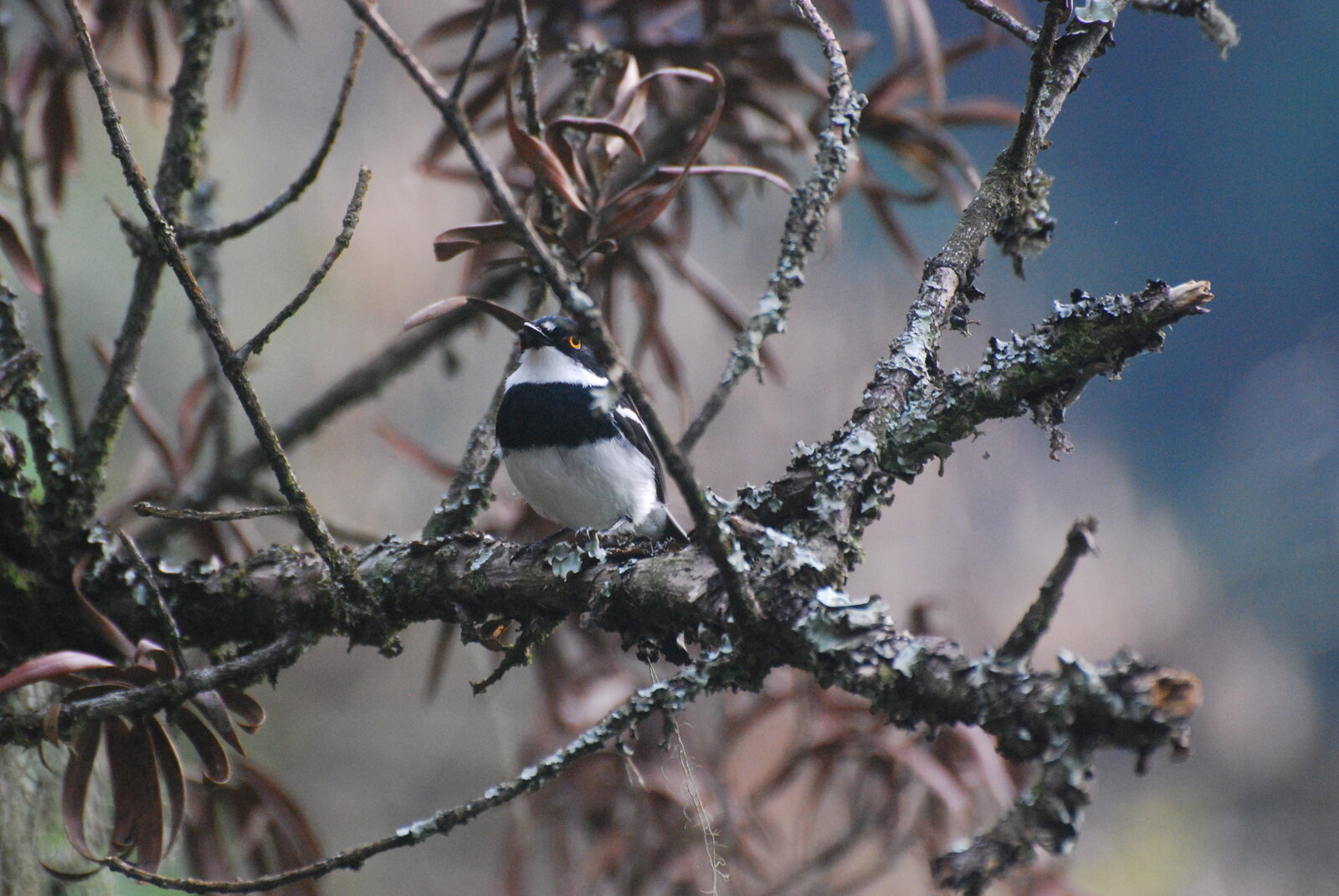
Like the Ituri Batis but larger, inhabiting undergrowth at higher altitudes. A very broad black breast-band and two small white spots on the fore-crown (like headlights) are distinctive. Sexes differ only in eye colour — yellow in the male, orange or red in the female.
The song is a regular, mid-range mournful piping on the same note, "heeee-heee-heee", the female often accompanying with quick rasps.
An Albertine Rift endemic, locally common in forest from 1,600 m to 2,600 m with a preference for undergrowth and mid-level tangles. In our area it is found in the large zone from the suspended bridge to the bamboo zone, extending to Kihalo, back to Samalira and the Riverside circuit.
Feeds on insects and worms found in lichen and moss on tree branches; it can also behave like a flycatcher, chasing little beetles, flies and mosquitoes.
Its breeding is not well known — it is shy but very active, constantly moving yet tending to stay hidden in the foliage. It keeps to mid-level foliage in undergrowth, 2–6 m above the ground and also in the lower canopy of tall trees, which is likely where it nests.
Moves in short flights within a small range, without showing itself for long.
Our guides know where to find it along the Kilembe Trail. Let us build a trek around the birds you most want to see.