
An iridescent dark-blue-headed sunbird of the lower montane forest, commonly seen on the Kilembe trail all year round.
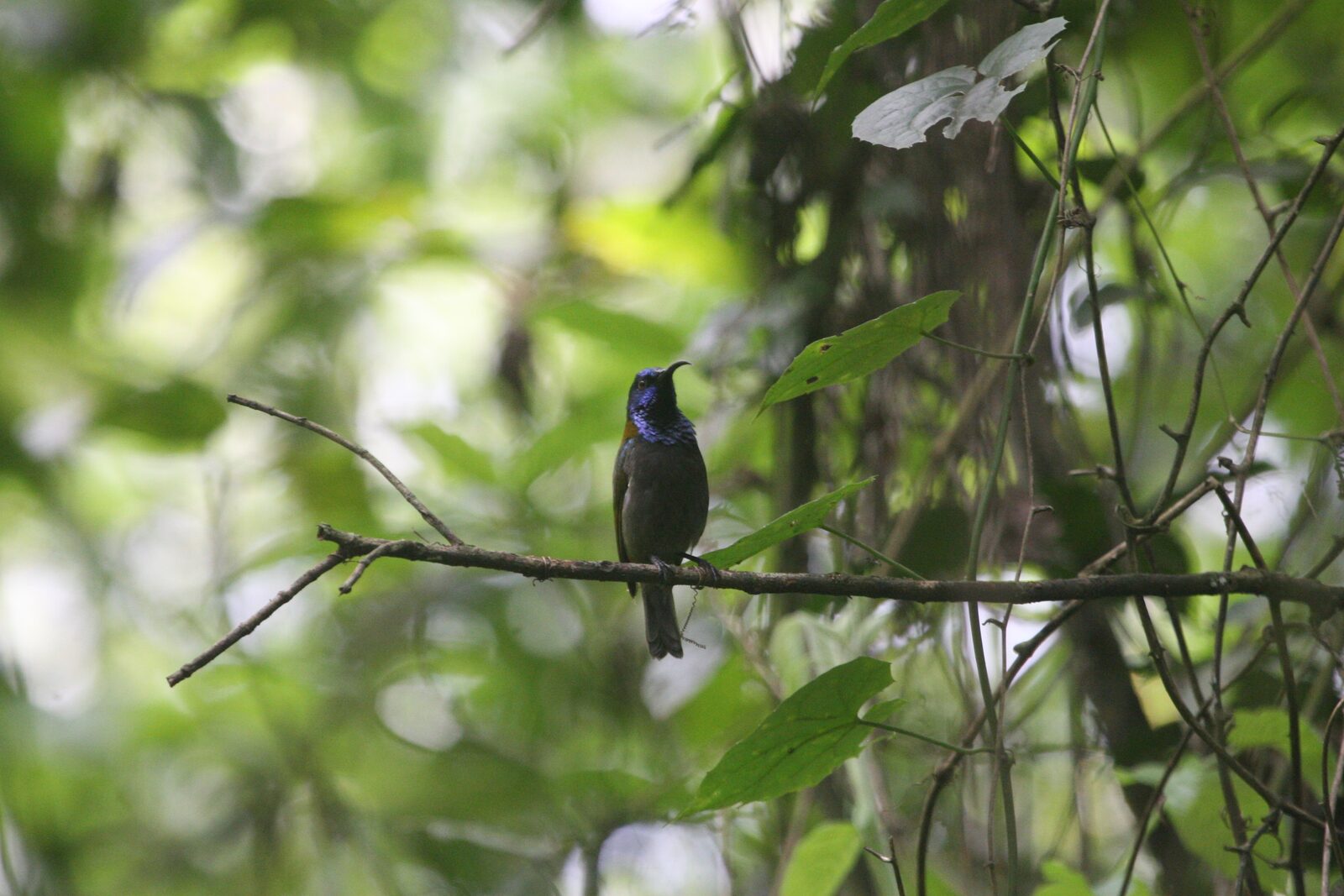
The adult male has the head, throat and upper breast iridescent dark-blue with a violet sheen, a dark-saffron olive mantle and a blackish belly. Eyes are bright red and the pectoral tufts creamy-yellow (there is no non-breeding plumage). The female is similar but sootier-grey. The similar Green-headed Sunbird has a greener head, moss-green back and is paler-grey below.
The call is a spitted "zit", often given in flight. The unusual song is a long, loud, rolling, spitted series that undulates like a sine wave.
Found in montane forest along the Albertine Rift, locally common from 1,400 m to 2,700 m. In the Rwenzori it is seen from 1,730 m to 2,650 m — from the National Park gate at Kilembe up to Sine Camp — where it favours flowers such as Melchiora schliebenii and Impatiens niamniamensis.
Feeds on nectar from flowers, mostly in the lower level of the forest, and will also take insects when feeding young.
The breeding season is mostly January to April/May, depending on weather. Pairs stay together for life; the female lays 1–3 eggs in a purse-shaped nest of plant fibres, moss and spider webs, hung from a branch. Eggs hatch in about 18 days and both parents rear the chicks.
Not a migrant — it moves within its territory looking for food, up and down through bushes, thick forest and some open areas. Commonly seen all year on our Kilembe trails between 1,730 m and 2,650 m.
Our guides know where to find it along the Kilembe Trail. Let us build a trek around the birds you most want to see.